What to post when you have nothing to say

It is eleven at night, the composer is open, and the cursor is doing that thing. You know you are supposed to post. You have been told to be consistent. And you have, apparently, nothing to say.
Then you close the app, and on the way to bed you remember four things that happened today that you could have written about, none of which occurred to you while you were staring at the box.
Nothing to say is almost never true
The blank feeling is not an absence of material. It is a retrieval failure. You are asking your brain an impossible question, which is "what is interesting?", in the abstract, with no cue, under time pressure, at the end of the day.
Nobody can answer that. What people can answer is a specific question about a specific afternoon. Change the question and the material comes back, because it was there the whole time.
The five places it already lives
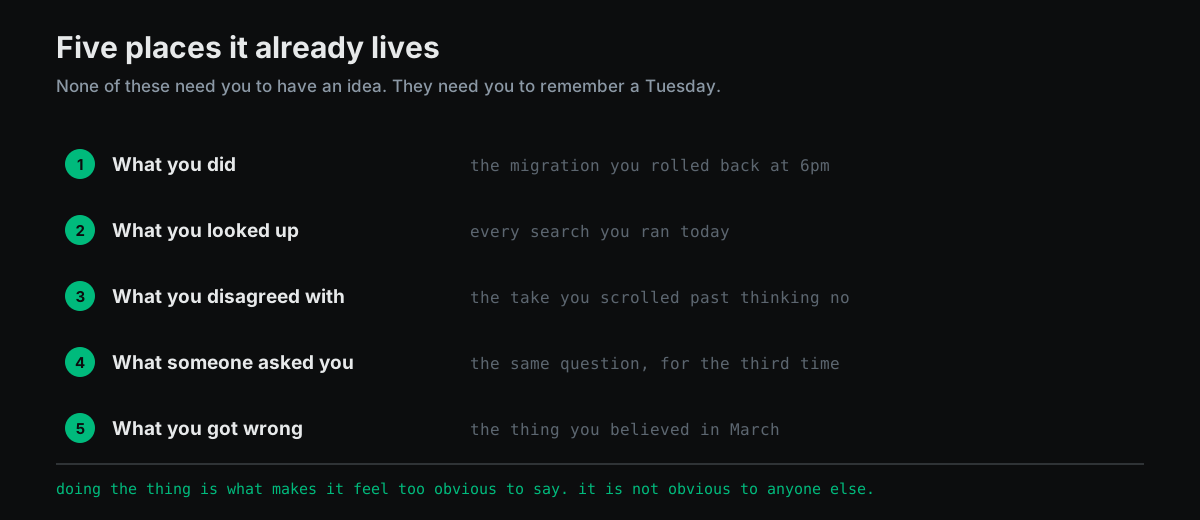
What you did. Not the polished version. The actual task: the thing you fixed, shipped, deleted, argued about or gave up on. This is the richest source and the most neglected, because doing something makes it feel ordinary to you and it is not ordinary to anyone else.
What you looked up. Every search you ran today was a question you had. If you had it, other people have it, and you now know something they do not. Your browser history is a list of post topics written by someone who knows exactly what you find confusing.
What you disagreed with. You read something this week and thought "that is not right". That silent objection is a post, and it is a good one, because it is already a position rather than a summary. The flat contradiction is one of the strongest ways to open.
What someone asked you. A support ticket, a DM, a question on a call. Someone cared enough to ask, which is the strongest signal of demand you will ever get for free. If one person asked, the answer is worth writing down once, publicly.
What you got wrong. The belief you held in March that turned out to be false. Corrections are rare and they make you answerable, which is exactly why people stop for them.
Why "what I learned" beats "what I know"
There is a trap in the middle of all this, and it is the instinct to wait until you are an authority on something before writing about it.
Posts that teach from a position of settled expertise are competing with everyone else who knows that thing, and they read as generic, because settled knowledge is by definition the part that is already widely available. Posts about what you learned this week compete with nobody, because nobody else had your week.
It is also the difference between a post that could have been written by anyone and a post that could only have been written by you, which is the same distinction behind the tells that make a post read as AI.
You are not short of ideas, you are losing them
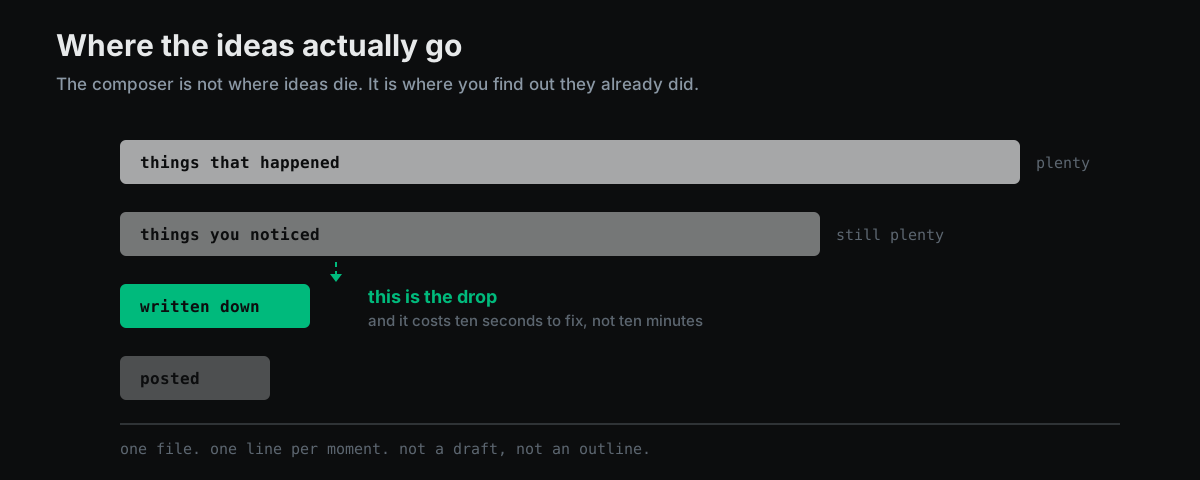
Plenty of material happens. Some of it you even notice, usually mid task, with your hands full. Almost none of it gets written down, and by eleven at night it is gone. The composer is not where ideas die. It is where you discover they already died.
The fix is embarrassingly small. Keep one file, one note, one pinned message to yourself. When something happens, put one line in it. Not a draft, not an outline, one line with enough detail that future you can reconstruct the moment.
- Ten seconds, not ten minutes. If capturing costs real effort you will skip it exactly when you are busy, which is when the good material happens.
- Write the specific thing, not the topic. "Pricing" is useless in a week. "Raised Pro to 49, two customers asked why, both stayed" is a post.
- Include the number if there was one. Numbers are the first thing you forget and the first thing that makes a post credible.
One Tuesday, worked through
Suppose the line in your note file says: "welcome email going to spam for outlook users, four days to find, one DNS record".
That is at least four different posts, and which one you write depends on nothing more than the angle you pick.
- The admission. Open on the cost. "Our welcome email went to spam for every Outlook user for four days." The reader wants to know how that happens.
- The lesson. Open on the fix being smaller than the search. "The fix was one DNS record. Finding it took four days."
- The practical one. The actual check other people can run tomorrow, which is the most useful and the least dramatic.
- The systems one. Why nothing alerted you, and what you changed so it would.
Same raw material, four posts, none of them requiring a new idea. This is what people mean when they say consistency is a systems problem rather than a creativity problem.
Three things that feel productive and are not
The big idea list. Forty topics in a spreadsheet, none of which you will ever write, because a topic is not material. "Thoughts on hiring" is a category, and you cannot post a category.
Evergreen tips. Generic advice is infinitely available and costs the reader nothing to skip. It also gives you no way to sound like yourself, because there is nothing of yours in it.
Rewriting posts that did well for someone else. Their post worked because of their context and their audience. Stripped of both, you are shipping the shape without the substance, and the shape is the part readers have learned to ignore.
Where a tool actually helps
Idea supply has two halves and they are not the same problem. The half a tool cannot do is capture: nobody else was in your Tuesday, so nobody else can put that line in your note file.
The half it can do is the second one. MomentX reads your last sixty days and finds the formats and angles that earned reach on your account, so when you bring the raw line, the draft comes back in a shape that has already worked for you rather than a generic one. The Engage queue does the same job from the other side, by surfacing what your niches are actively talking about right now, which is often the cue that reminds you of the thing you had forgotten.
You still supply the Tuesday. That part is not outsourceable and it is the part that makes the account yours.
Where this fits
This is the input problem. The rest of the blog is what to do with the input once you have it: how to open, when to send, how to borrow distribution while your own is small, what a visitor sees when it works, and how to read a quiet week without panicking. If you are starting from nothing at all, begin with the cold start.
Bring the Tuesday, we will bring the shape
MomentX turns your own history into drafts that open the way your best posts opened, so the blank box stops being the hard part.
Try MomentX free for 5 days