The cold start: what to do before you have an audience

Read enough growth advice and you notice something. Post at your best hour. Check your median. Double down on the format that works. Every one of those requires a thing you do not have yet, which is data about an audience. At forty followers and eleven posts there is no best hour, no median worth the name, and no format that works, because nothing has worked yet.
We have written a lot of that advice on this blog, and it is all still true. It is just true later. This post is about the part before it applies.
Why the standard playbook does not run at zero
Three things are missing at the start, and they are missing together.
- No signal. Twenty posts at forty views each do not separate into good and bad. The differences you see are noise, and optimising against noise moves you in a random direction with great confidence.
- No distribution. The feed extends reach in steps, and the first step is your followers. Forty followers means the first sample is forty people, most of whom are not online right now. There is nothing for the second step to react to.
- No memory. Nobody recognises your name yet, so every post has to work on strangers with no accumulated reason to trust you.
Which is why timing advice, format advice and analytics advice all quietly fail at the start. They are optimisations, and there is nothing to optimise.
Only two things work when you have nothing
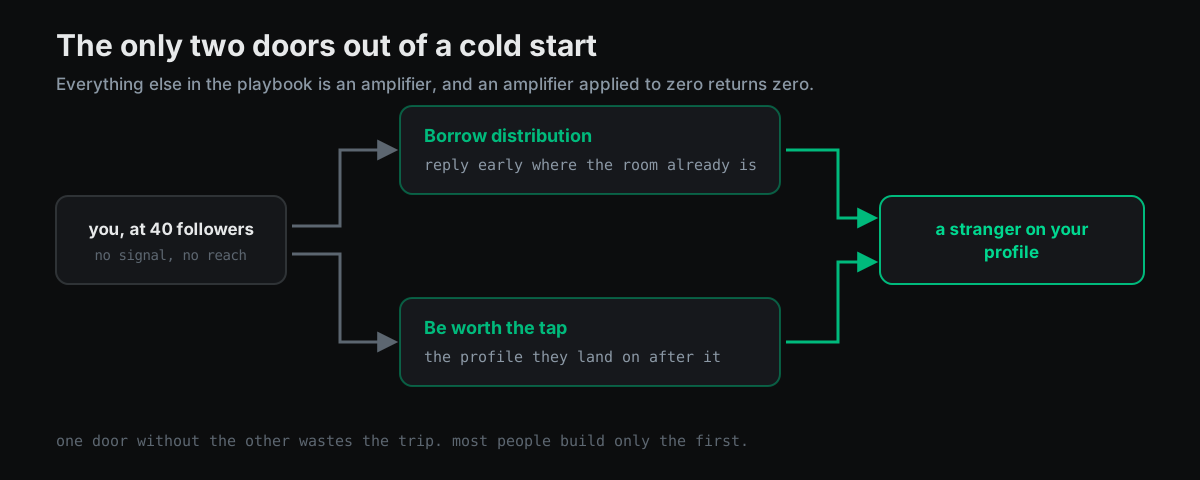
Borrow distribution. You cannot generate reach, so use someone else's. A reply on a post that is already moving puts you in front of an audience that is already assembled and already interested in the subject. This is the single highest leverage thing available to a small account, and we wrote the mechanics in the reply strategy.
Be worth the tap when it comes. Borrowed attention gets spent on your profile, not on your reply. If the profile says nothing, the borrowed reach evaporates and you conclude that replies do not work. They worked. The landing page did not. That whole failure mode is why your posts get views but no followers.
Everything else in the standard playbook is an amplifier, and an amplifier applied to zero returns zero.
Weeks one and two: pick a room, not a niche
"Choose a niche" is the advice, and it sends people into a week of thinking. Do something narrower instead: find the twenty or thirty accounts whose replies you would actually read, and open the app in that room every day.
A room is easier to pick than a niche because you can see it. You are not committing to a topic forever, you are choosing whose conversations you want to be part of this month. The subject emerges from the room, and it emerges more honestly than it would from a planning session.
Two rules for picking. Choose accounts whose posts get replies, not just likes, because a post with a busy reply section is a room with people in it. And choose a size where you are not the fortieth reply, because the earlier you land the more of the post's distribution you ride.
Weeks three to six: show up where the room already is
The rhythm that works is boring and it is the entire job at this stage.
- Reply first, post second. Replies are borrowed reach and posts are owned reach, and you have almost no owned reach. The ratio should feel lopsided for a while.
- Land early. Within the first hour or two of a post you want to be in. Later replies are read by fewer people, and the drop is steep.
- Add something the author did not say. A number, a counterexample, a question only a practitioner would ask. Agreement is invisible, and "great post" is worse than silence because it costs you a reputation slot.
- Post anyway. Three or four times a week, into what feels like an empty room.
That last one confuses people, so it is worth being explicit about why you post when nobody is reading.
What posting is for when nobody is reading
It is not for reach. At this stage your posts exist so that the person who taps your name after a good reply finds something there. The wall is the close, and the reply was only the pitch.
It has a second use. Posting into a quiet room is how you find out what you actually have to say, at zero social cost, before anyone is watching closely enough for a bad post to matter. That is a rare and temporary advantage and most people waste it waiting until they feel ready.
Write about the specific thing you did this week. The first line matters more than the rest, and at this stage the easiest good first line is a real number or a real mistake, because those are the two things you have that nobody else does.
What to measure when you have no numbers
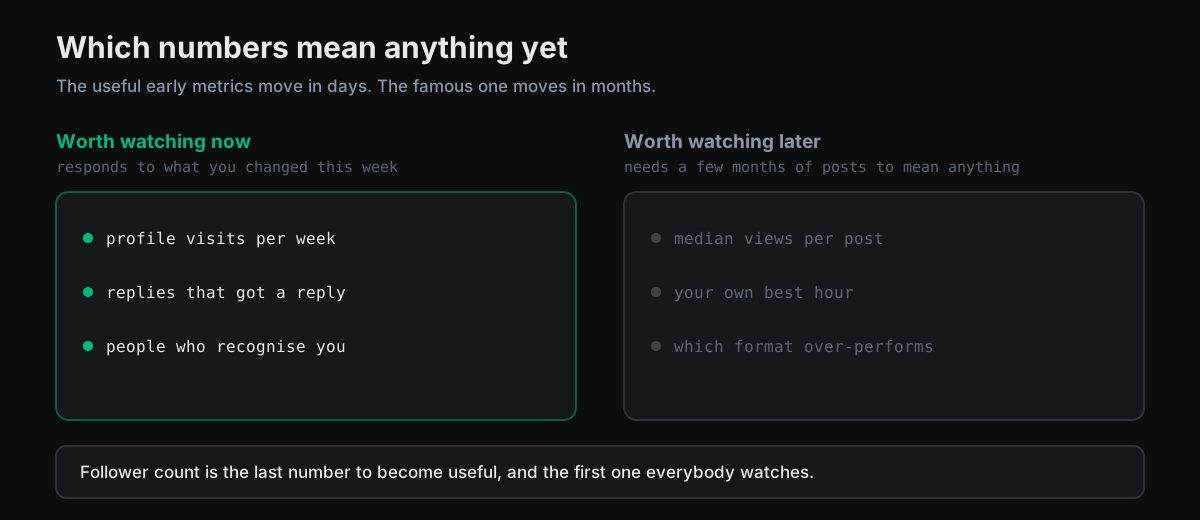
Follower count is a terrible early metric. It moves slowly, it moves in lumps, and it tells you nothing about which of the things you did caused it. Watch these instead.
- Profile visits per week. This is the real output of replying. It moves within days and it responds to what you changed.
- Replies that got a reply. A conversation is worth more than a like, and the accounts that answer you are the beginning of an actual network.
- Whether anyone recognises you. Being remembered by ten people in one room beats being seen once by a thousand strangers, and it is the thing that compounds.
Once you have a few months of posts behind you, the analytics advice on the rest of this blog starts to apply: finding your own posting window, and reading a quiet week correctly instead of assuming the worst about it. Not before.
The four traps
Follow for follow. It buys a number and pays with reach, because accounts that do not read you teach the feed that your posts do not get read.
Engagement pods. Same problem with extra steps, and the pattern is exactly the kind of thing described in what actually gets your distribution cut.
Rebuilding the profile every week. Change the bio once, properly, then leave it alone and go and do the work. Rewriting it is a way of feeling productive without being seen by anyone.
Waiting until you are ready. The most expensive one. There is no threshold of expertise you cross before you are allowed to post. The posts are how you get there.
Where a tool fits, and where it does not
We should be straight about this, because it is the honest answer rather than the convenient one. MomentX learns your voice by reading your last sixty days. If you have eleven posts, there is very little to read, and the profile it builds will be thin. A tool cannot infer a voice from writing that does not exist yet.
What it can do at that stage is the other half: the Engage queue surfaces posts from your chosen niches that are recent and already moving, which is the finding problem, and finding is most of the work when you are starting. The writing help gets better as you give it more to read, which is a strange thing for a product page to admit and a true thing to tell someone deciding what to do this month.
If you are at forty followers, the honest advice is that the first six weeks are replies and showing up, and no tool replaces that.
Where this fits
This post is the one before the others. Once you have an audience and a few months of posts, the rest of the blog applies: what the algorithm rewards, how to open a post, how to not sound like everyone else, and what a stranger sees when they arrive. Read them in that order when the numbers are big enough to mean something.
Find the rooms worth replying in
The MomentX Engage queue surfaces posts from your niches, under 16 hours old, with real traction, so the finding part stops eating your evening.
Try MomentX free for 5 days